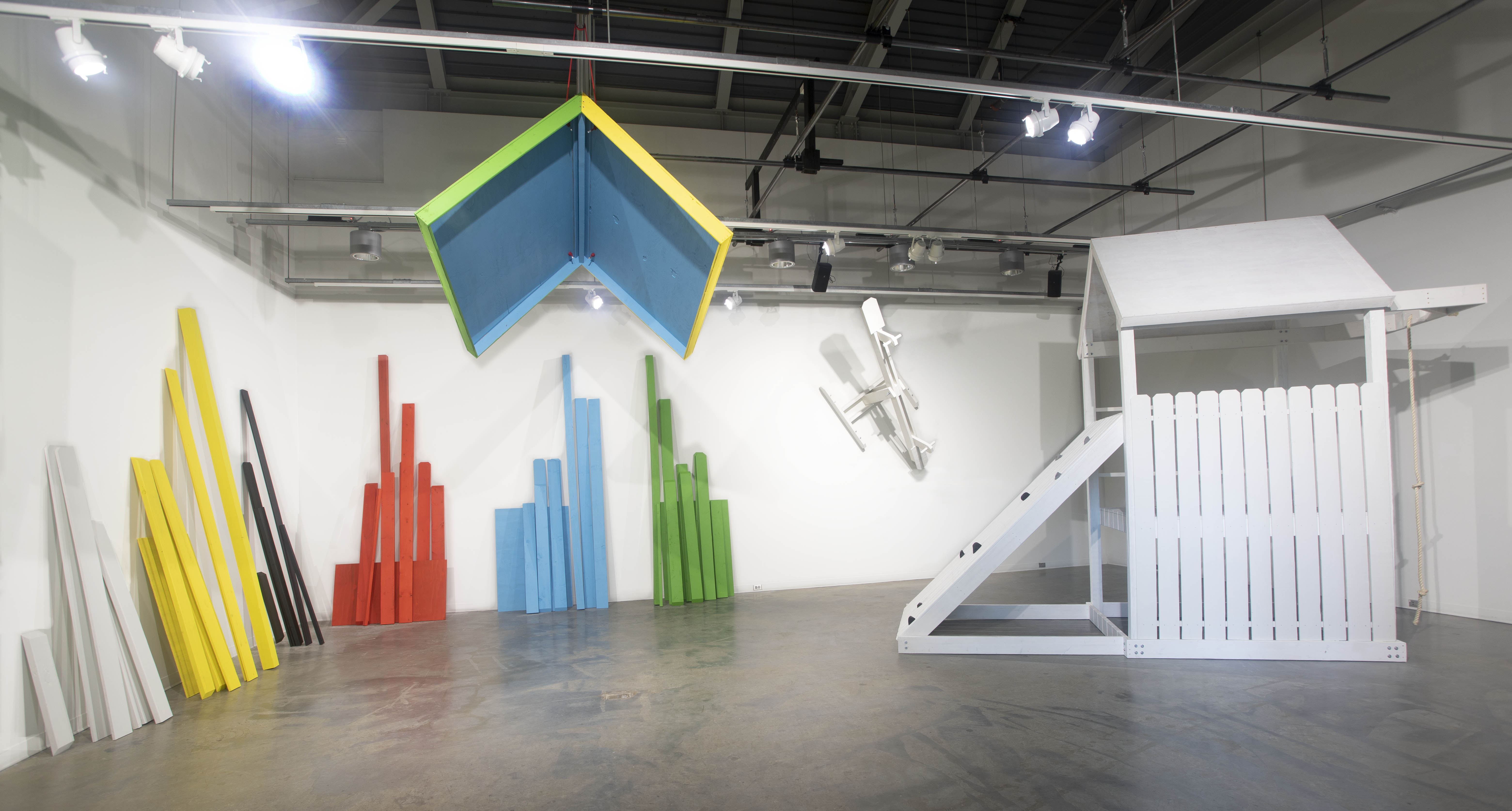
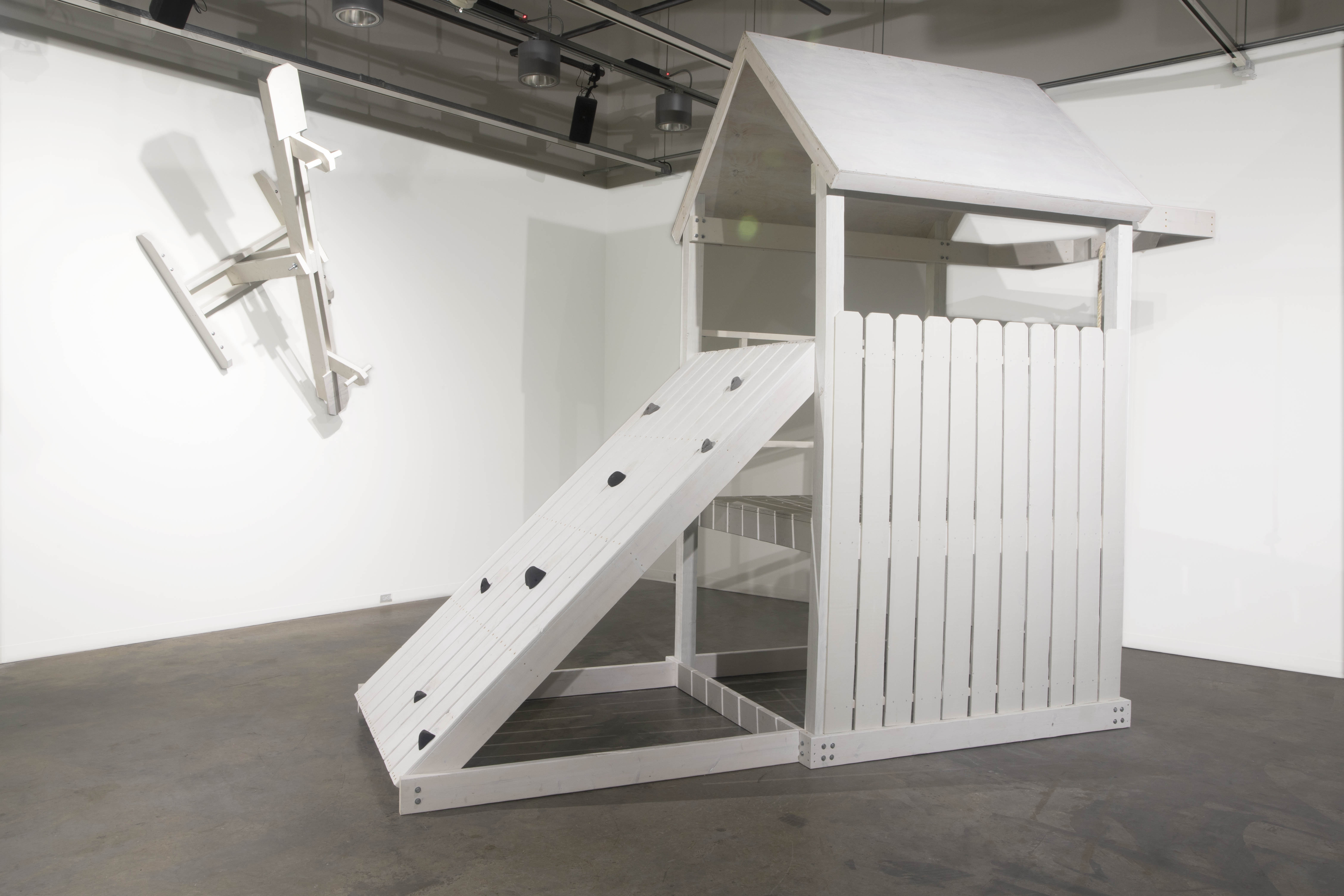
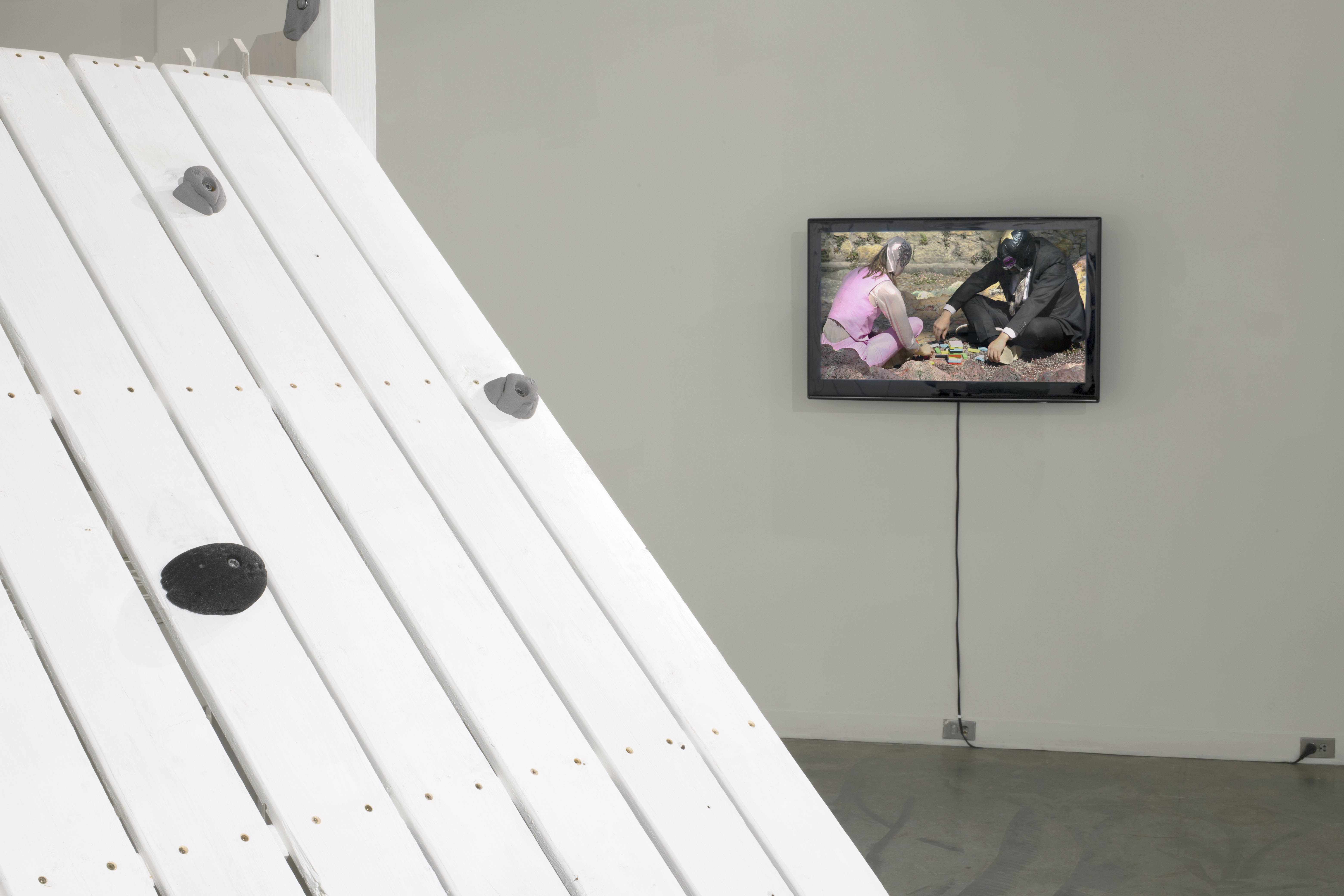
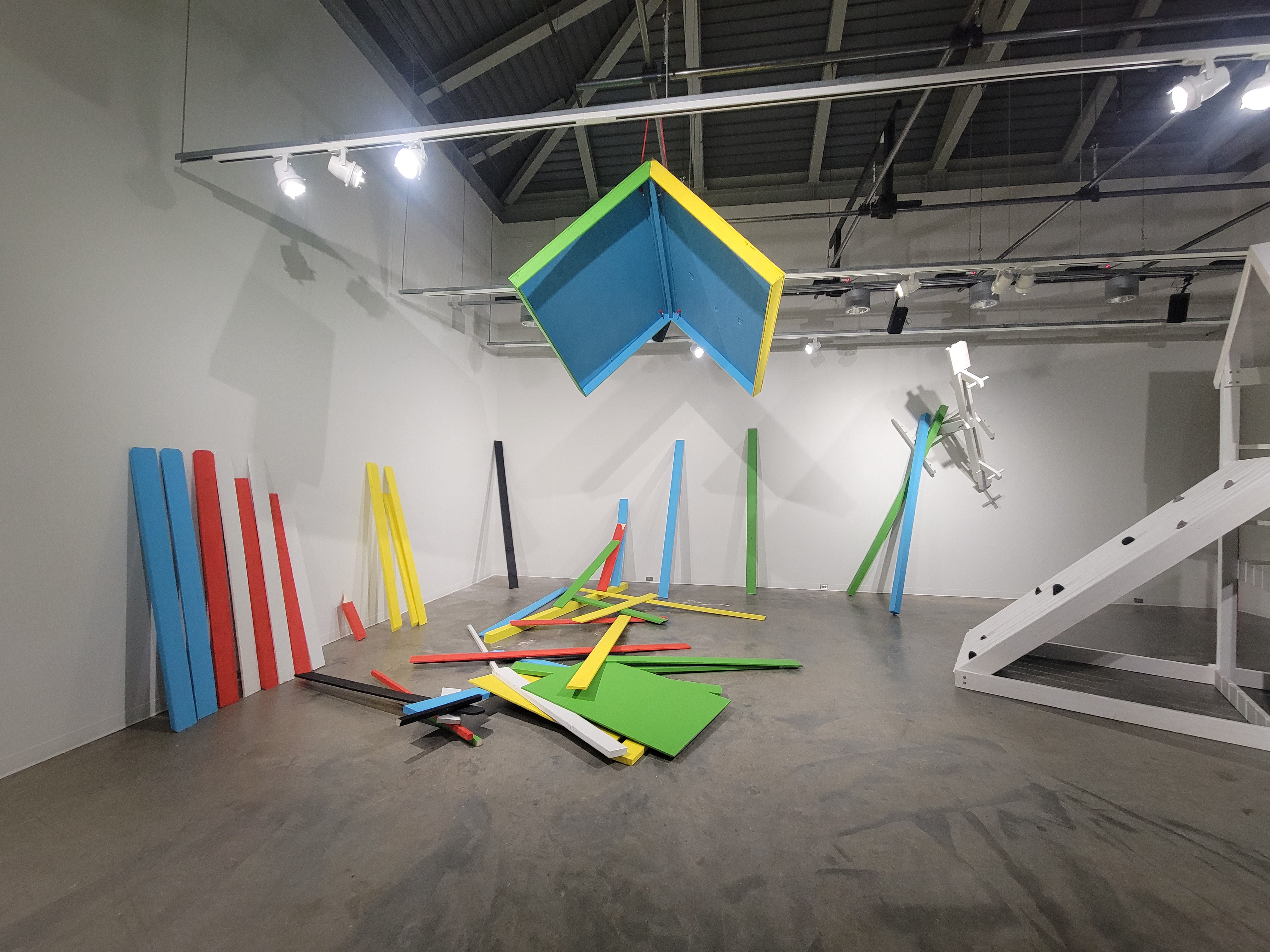
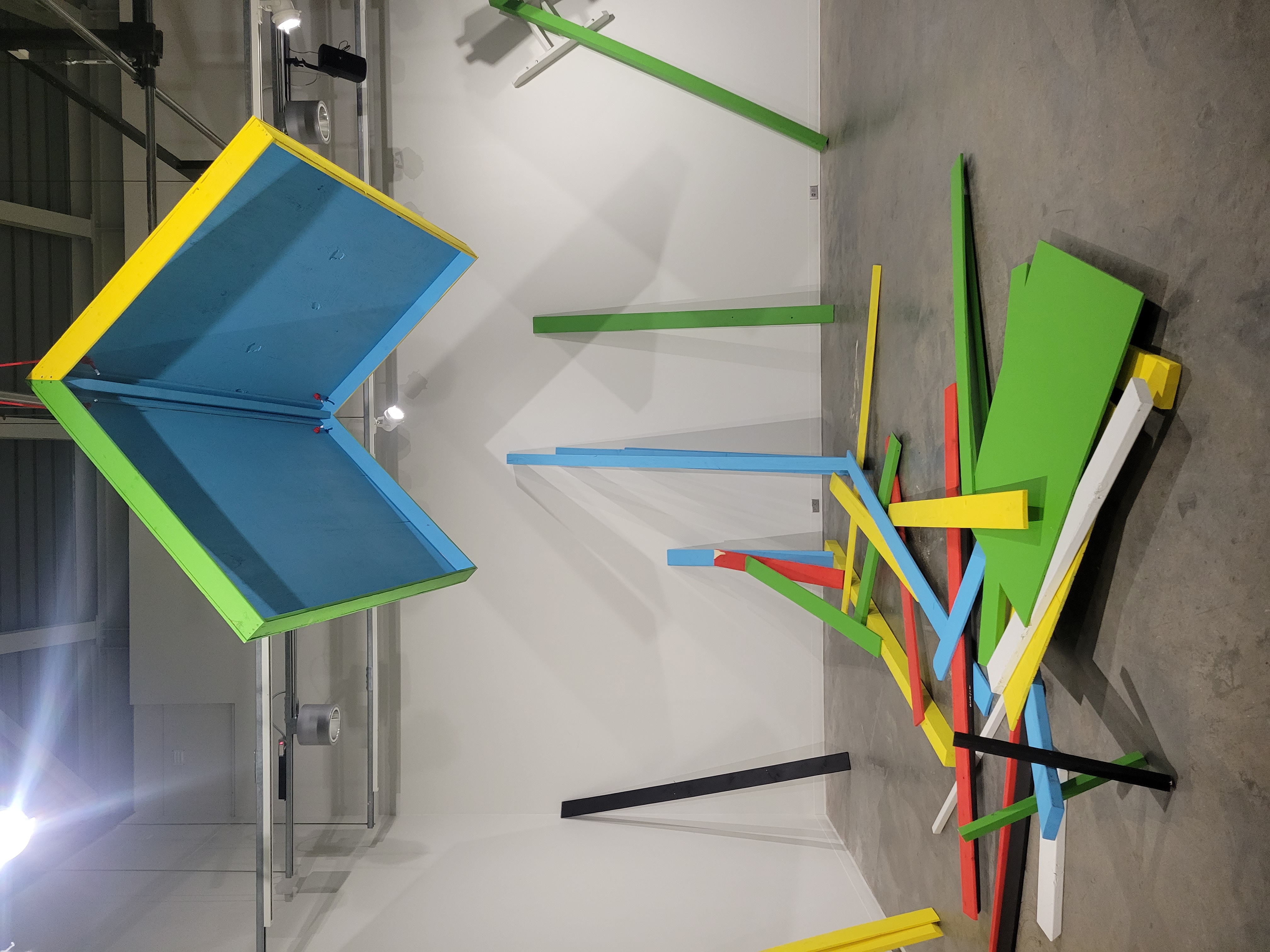
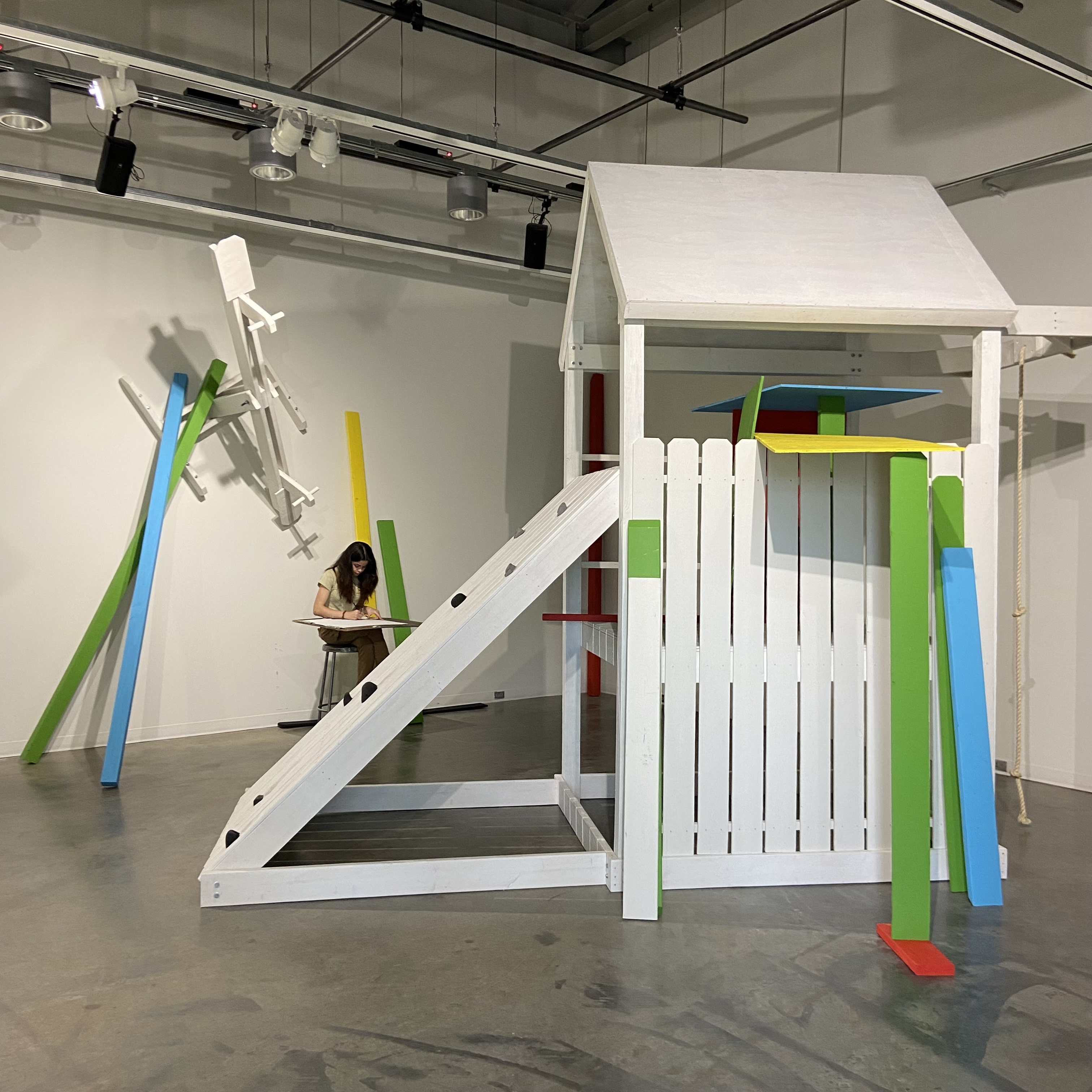
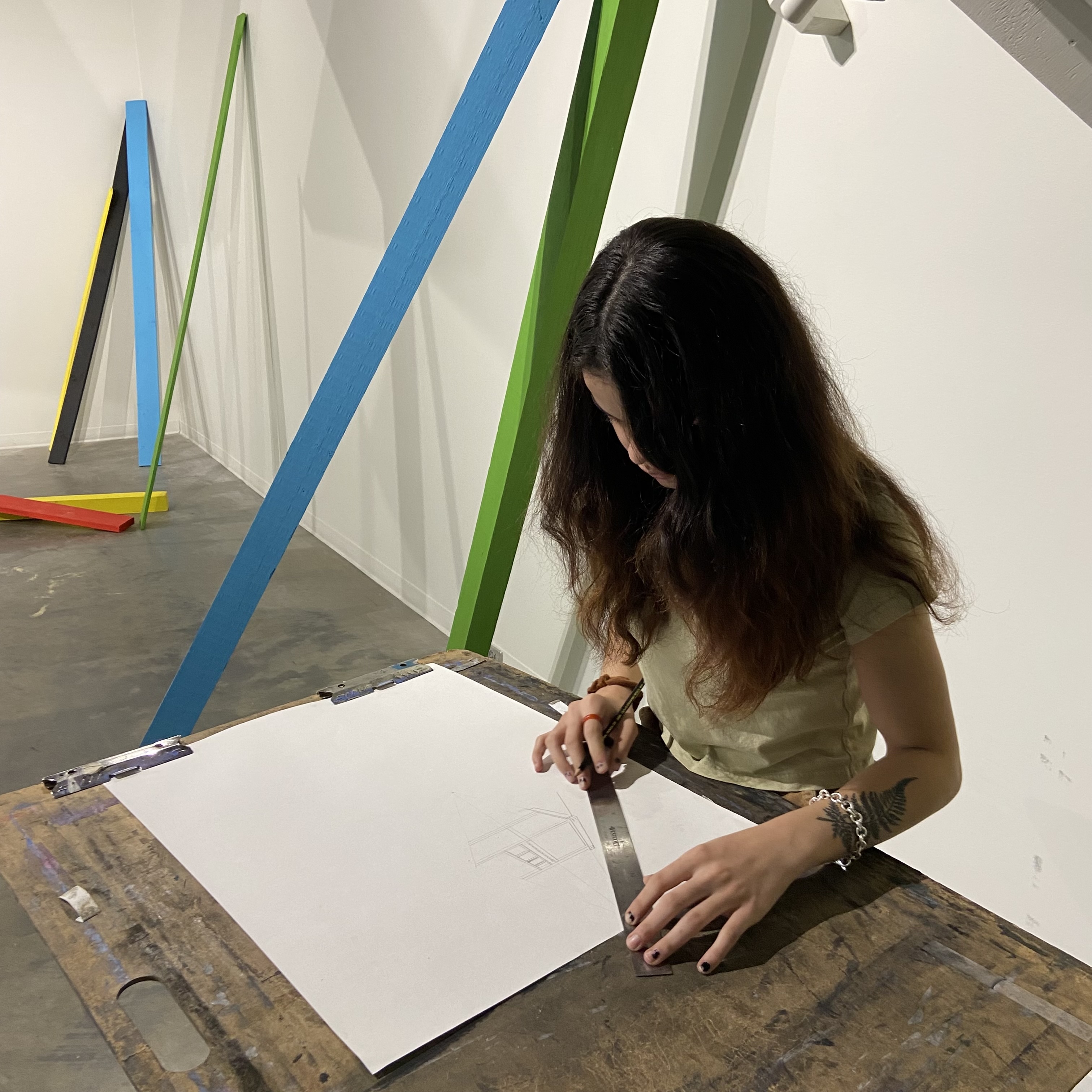
AMBI Playground was a participatory installation and process presented at Ruffin Gallery, in the Department of Art at the University of Virginia, in 2024. The project began with a question about play as a form of learning, reconstruction, and the collective production of meaning. The prefix ambi suggests what is “around” or “on both sides”; from this ambiguity, the exhibition proposed a third space: a place open to doubt, error, collaboration, and the emergence of unforeseen forms.
For the project, I visited and took as a reference the history of junk playgrounds and adventure playgrounds: play spaces that emerged in postwar contexts, where children and communities built with construction debris, found materials, wood, boxes, and rubble. As part of the research, I visited Skrammellegepladsen in Emdrup, Copenhagen, considered the first planned junk playground and a foundational reference for adventure playgrounds. There, one of the parents still connected to the program, guided me through the site. Through this visit, I was able to learn about the work of the teachers, the everyday dynamics of the park and the spaces designed, built and transformed by the children.
I was especially struck by the way play was shaped by concrete forms of cooperation, conversation, and shared decision making. The park welcomes children from the neighborhood in activities that complement school and it functions as a learning community among children, teachers and adults close to the program. This experience allowed me to understand the reference not only as a historical or documentary precedent, but as a living archive: a pedagogical, spatial and social model that still functions, transforms itself and produces community.
Unlike a conventional playground, designed for predetermined uses, these spaces value experimentation, self-construction, destruction, and recomposition as forms of social imagination. In AMBI Playground, this history became a tool for thinking about the exhibition space not as an arid or final place, but as a field of possibilities.
The colors of the installation come from a transformed copy of Jenga, commonly found in informal street markets in Bogotá, Colombia. This reference introduced another layer to the project: play as something that circulates through copies, substitutions, economies and everyday forms of reinvention. The familiar colors of the game entered the gallery not as decoration, but as traces of a material culture shaped by use, availability and informal exchange.
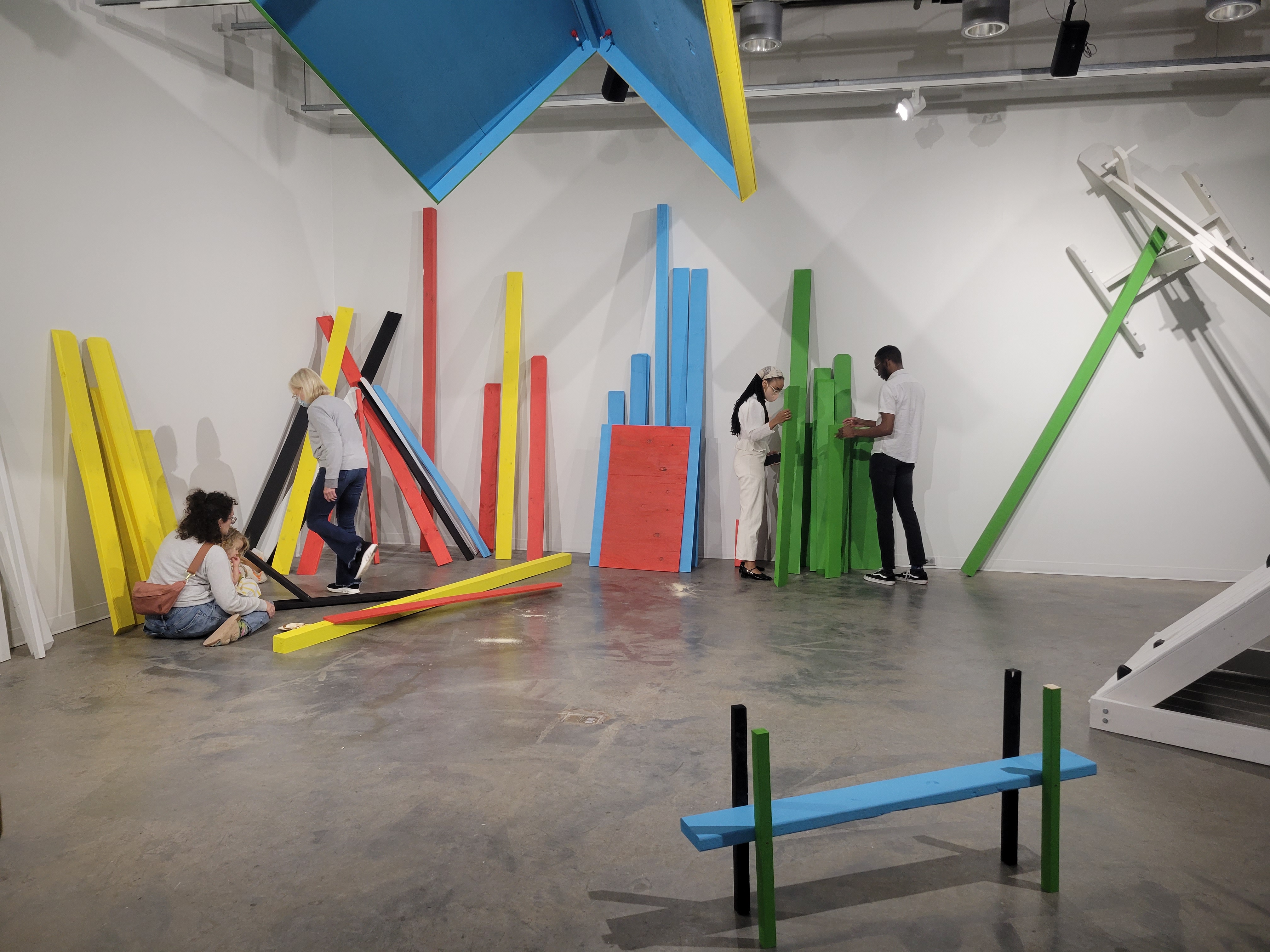
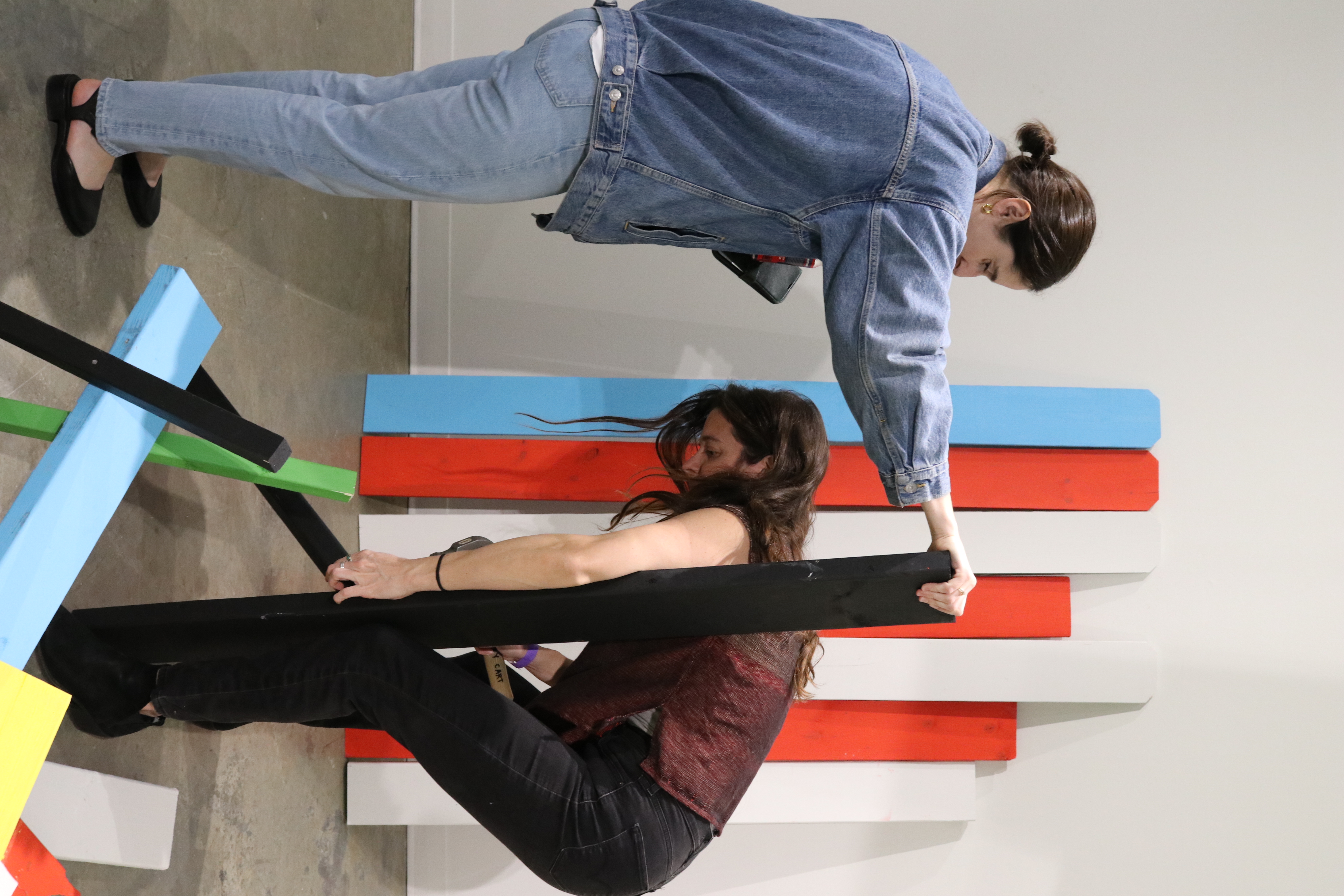
This installation relates to my previous participatory works, in which the public is not merely a spectator, but an agent within a system of materials and shared decisions. As in The Promise of Disorganization, the exhibition was activated as a pedagogical space: UVA students and professors used it as a classroom, a meeting place and a platform for conversations, exercises and collective processes. In this sense, the work was not only observed: it was inhabited, modified: put to use.
After the exhibition was dismantled, its materials continued to circulate within the everyday life of the Department of Art. Rather than disappearing as the remains of a temporary installation, they were reused by students and incorporated into their own processes, workspaces, and daily routines. This continuity extended the project beyond the duration of the exhibition and reinforced one of its central ideas: play, learning and collective construction can persist through provisional, informal and shared forms.
The project also opened a reflection on ruin, residue, reconstruction. The precarious or unstable materials were not used as scenography, but as elements capable of holding latent histories and generating new uses. In this sense, AMBI Playground proposed thinking about common space through the provisional: that which is not yet fully defined, that which can still be reorganized, repaired or imagined otherwise.